Get a great new deal on comics toys and more every 24 hours!

Posts Tagged ‘vertigo comics’

Joe the Barbarian #1 (of 8) Comic Review

Wednesday, February 24th, 2010 by Carl Doherty under Comic Book Reviews

DC/Vertigo, $0.99
Story: Grant Morrison
Art:
Sean Murthy
Colours:
Dave Stewart

Joe the Barbarian is part of an increasingly popular genre; the adult kid’s book. Joe’s spacious attic bedroom is one that every adult wishes they lived in as a child (as opposed to every current child wishing they had), with 80s action figures lining the floor and a toy railway set dangling precariously from the ceiling. And like the majority of fictional teenage outcasts, Joe possesses proficient drawing skills.

Joe the Barbarian #1

Joe the Barbarian #1

Of course, Joe the Barbarian is the latest effort from Grant Morrison, and it comes as no surprise when Joe’s reality begins to crumble around him, and the tiny toys in his room (including analogues of G.I. Joe’s Snake Eyes and the Transformers) come to life.

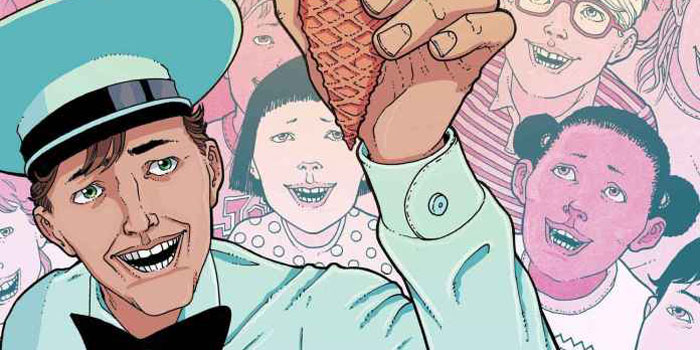
Quite why any of this happens, I’m not entirely sure. Issue 1 of Joe the Barbarian is little more than an exercise in character building, but it’s difficult to object to Morrison’s languid pacing when the story is introduced as well as this. The art by Sean Murthy and Dave Stewart really is in a league of its own, depicting Joe’s mundane life with a sense of the fantastical while making the hallucinatory sequences – though I suspect they’re much more – look almost plausible.

On the merits of the first issue alone, it’s difficult to say exactly where Morrison’s plot is heading, and whether Joe the Barbarian will be worth investing in. While Murthy’s art and Morrison’s track record would suggest yes to the latter, the setup between Joe and an equally timid female admirer is uncharacteristically clichéd for Morrison, and Joe’s problems (diabetes, workaholic mother, dead father) feel as though they’ve been lifted from an uninspired Hollywood kid flick.

While I have high hopes for Joe the Barbarian, I guess the question needs to be asked: were this leisurely paced premier issue scripted by an unknown writer, would it be so readily embraced?

8/10

  • Share/Bookmark

Daytripper #1 Review

Monday, December 28th, 2009 by Carl Doherty under Comic Book Reviews

Vertigo, 2009
By: Fabio Moon, Gabriel Bá
Colours: Dave Stewart

Eisner Award winning Brazilian duo Fabio Moon and Gabriel Bá’s new series Daytripper is a mature title in the truest sense. And by that I don’t mean that this is a comic that feels the need to shove tits and incest in the reader’s face to get a reaction, a la Vertigo’s recent Greek Street, or even that Daytripper reads as though it’s been marinated in the adolescent angst or philosophical ramblings of many other so-called “mature” titles.

Daytripper #1 Review

Daytripper #1 Review

It’s not even a flashy first issue, instead unhurriedly introducing us to Brás, a bored obituary writer who’s long procrastinated more ambitious projects. And that’s about it. Only in the final pages does ‘32’ suggest where Daytripper might be heading, and what happens next is genuinely still anyone’s guess.

There’s a lovely sense of subtlety here, from Bras’ discourse with his dog Dante, to the manner in which the recently deceased play a part in his daily stream of consciousness. Fans of The Umbrella Academy or Ursula will be surprised quite how reserved the book’s art is, but there’s a superb sense of pacing on display here that lends clout to even the most (seemingly) insignificant scenes. Unlike most first issues, ‘32’ takes its time introducing us to its substantial protagonist. Often such an approach feels sluggish and directionless, but here I was captivated by the deliberate storytelling.

Some will pick up Daytripper #1 and reject this slow burning introduction to what looks to be a cracking series, dismissing it as a book where “nothing happens,” while others will hopefully appreciate it for just that. Like Sideways, A Serious Man and the very best Woody Allen movies, it’s likely to appeal largely to writers both professional and aspiring. Pretty much anyone who counts, then.

8/10

  • Share/Bookmark

Neil Gaiman’s Neverwhere TPB Review

Tuesday, July 29th, 2008 by Carl Doherty under Graphic Novel Reviews

Originally published 2006, DC Vertigo
Writer: Mike Carey
Art: Glenn Fabry

There’s something foreboding about any book which gives front cover prominence to author over title. It’s a tell-tale sign that a writer has reached a stage wherein his name bears more weight than the quality of his/her material. It’s even less reassuring when said writer has had little input onto the work that bears his name.

Lucifer’s Mike Carey does a faultless job of a thankless task, adapting the original novel’s third-person prose into a first person narrative as awkward and perplexed as its bewildered protagonist. Gaiman’s inspired dialogue occasionally hits the high notes of pretentiousness, but the entire thing moves by at such a pace that it really doesn’t matter. Neverwhere is a floating market of ideas. Some work, others don’t; there’s rarely enough time to notice.

Neil Gaiman’s Neverwhere TPB

Neil Gaiman’s Neverwhere TPB

Neverwhere’s abstract plot is relatively pedestrian, following the adventures of generic everyman Richard Mayhew, a browbeaten London office worker. When Richard stumbles across the unconscious body of the attractive, pallid Door, he is sucked into London Below, a postmodernist’s wet dream, a world under, above and between our London.

Neverwhere has a plot that is best enjoyed rather than explained, making sense only in the sense that it doesn’t. Those inclined to question their fiction may find the journey a little arduous.

With names like the Angel Islington and The Marquis de Carabas, London Below’s inhabitants are amalgamated from the usual Gaiman influences; mythology, folklore, religion, the Commedia dell’Arte, and the obligatory cute Goth chick, his premium entities are villains Mr Croup and Mr Vandemar, a little/large combo of softly spoken assassins that feel like they’ve been banished from a dark, depraved Dickens. Raucously malevolent, the anticipation between their increasingly gruesome misdemeanours gives Mayhew’s passage through London Below a much needed state of urgency.

Glenn Fabry’s art should be prescribed as a nutritional supplement for the eyes, with several establishing panels that you could get happily lost in for several days. His facial expressions are almost on par with Dillon’s work on Preacher, conveying a charismatic empathy that the original TV version’s wooden actors never could.

Neverwhere isn’t an essential read, lacking the focus which established The Sandman and The Books of Magic classic status. It’s a forgettable but enjoyable read, never short on imagination but lacking any depth or lasting meaning. Though perhaps more importantly, it’s a successful novel to comic adaptation, losing nothing in translation. And those are a rarity indeed.

8/10

  • Share/Bookmark

WE3 Graphic Novel Review

Tuesday, July 29th, 2008 by Carl Doherty under Graphic Novel Reviews

2004, DC / Vertigo
Writer: Grant Morrison
Art:
Frank Quitely
Colours / inks: Jamie Grant

I’ve always considered Grant Morrison the Philip K. Dick of the comic medium. But writers both are inhumanly creative, incomparable to almost any other writer of their period. Like Dick, Morrison writes to pay the bills, churning out radically inconsistent work with unnerving regularity; and like the majority of Dick’s books, Morrison’s work often collapses under a multitude of whimsical ideas. But when Morrison hits the target, like Philip K. Dick he’s the best of his kind.

WE3 Graphic Novel review

WE3 Graphic Novel Review

We3 follows the fortuitous escape and arduous journey of lab experiments 1, 2 and 3 (dog, cat and rabbit respectively). The animals – referred to as biorgs – developed for covert missions and political assignations, are packed with enough firepower to cripple an entire army. When the project is decommissioned, the animals are to be put to sleep, but are freed – perhaps imprudently – by their compassionate creator Roseanne Berry.

We3 has been compared to The Incredible journey, but its themes of animal cruelty for its own sake are far closer to Richard Adam’s The Plague Dogs. Like Adam’s novel, the story is seen from both animal and human perspectives. The series’ original covers, a series of “missing pet” posters add another dimension to the fable, displayed by Bandit’s desire to be a “gud dog”; these animals were all once someone’s friend.

The implementation of a mastiff prototype as the fugitive’s primary threat seems a little contradictory, though to his credit Morrison does not resort to sentimentality as a lesser writer might. The feline, 2, kills with an almost sadistic glee, and many human lives are inadvertently taken by the sentient weapons as they traverse forest and city. Yet we still sympathise with the beasts; they are as much victims as those unfortunate enough to cross their paths.

Quitely’s art has been billed as a kinetic, “western manga.” Given the substandard nature of the majority of Japanese comics, that’s an insult. His panel composition is among the best there has ever been, showcased perfectly in an almost dialogue-free first part. Several pages feature intricate layouts of several dozen tiny panels, lending WE3’s commotion a remarkably dense pace; it definitely feels a lot longer than 3 issues.

Quite how the low-key ending manages to hit the heart with so few words is a mystery only the greatest science fiction writers could possibly answer. We3 may not be Morrison’s most creative or ambitious work, or indeed his most intelligent, but it’s perhaps his most effective.

9/10

  • Share/Bookmark

Fables: 1001 Nights of Snowfall Graphic Novel Review

Wednesday, June 11th, 2008 by Carl Doherty under Graphic Novel Reviews

2006, DC/Vertigo
Writer: Bill Willingham
Illustrators:
Esao Andrews, Brian Bolland, John Bolton, Mark Buckingham, James Jean, Michael Wm. Kaluta, Derek Kirk Kim, Tara McPherson, Jill Thompson. Charles Vess, Mark Wheatley

Fables’ strength has always been that, whether immersed in Bill Willingham’s universe or not, anyone fortunate enough to have survived childhood will be familiar with its myth, legend, folklore and fairy tale beginnings. There’s an instant comprehensibility to its ingenious premise that not only places us in the familiar territory of the worlds within the series, but the fantastical landscape we created as children, when these grisly and macabre tales were read to us as by innocently sadistic parents.

Fables: 1001 Nights of Snowfall

Fables: 1001 Nights of Snowfall

This is none more apparent than in 1001 Night of Snowfall, an iteration of the Persian fable of Scheherazade, in which envoy Snow White finds herself at the mercy of a sultan who systematically has the virgin he beds each night executed the following morning to ensure her honour to him. To impede the loss of her head, Snow White bemuses him with stories galore. One thousand and one, in fact.

But it’s the stories Snow imparts that form the core within this effective but underwhelming frame tale, a decuplet of anecdotes and character origins that flesh out Fables cast in a myriad of ways. Amongst others we discover what drove Bigby to become the Big Bad Wolf, and, in the book’s most heart-rending segment, the traumatising events that led to Flycatcher’s current state of mind. There are some seriously dark elements in here. Many of the shorts are laced with Willingham’s usual irony and tragedy, or disturbing truths that are only half revealed, such as Snow White’s history with the associated seven dwarves.

I could write everlastingly on the quality of the art on display here, but let’s just leave it at “overwhelming.” That is not to in any way undermine mark Buckingham’s work on the regular series, which obviously had tighter deadlines to adhere to, but the talents of Charles Vess, Tara McPherson, John Bolton and many more lends 1001 Nights an interior of cover quality art. This is the closest a graphic novel gets to being a coffee table book outside of anything by Alex Ross.

Rather than tell a separate narrative that could easily have been printed in the regular series, Willingham’s decision to pad out his creations in this manner works exceedingly well. Though not absolutely vital, 1001 Nights of Snowfall spreads precious extra layers of depth over a vastly populated realm that has already gone beyond multifaceted, without compromising the pace of the main run.

9/10

  • Share/Bookmark

New Reader’s Guide to Neil Gaiman’s Graphic Novels

Friday, June 6th, 2008 by Carl Doherty under Comic Book Features

With the success of the movie adaptation Stardust, as well as his novel American Gods, Neil Gaiman’s work is finally getting the mainstream attention it deserves. Though alongside Allen Moore, Gaiman has been one of the few American comic writers to enter popular culture, gathering critical acclaim from outside the comic book sphere, many of his appreciators may still not recognise his graphic novel work outside of The Sandman series and its numerous offshoots.

The Sandman - Neil Gaiman

The Sandman - Neil Gaiman

For the sake of brevity, I’ve concentrated on Gaiman’s work that is currently available in graphic novel format, presented in chronological order. The list far from extensive, but I think most would agree that I’ve covered all the classics. As ever with the comic industry, some of the publishing dates may be debatable – in most cases I have given the year in which the stories were published in their original comic format.

Violent Cases
1987

Gaiman’s first graphic novel collaboration with Dave McKean, in which a narrator recalls events from his childhood in Portsmouth, where he was taken by his father to be treated by an osteopath who once worked for Al Capone. In what would become a prevalent theme in Gaiman’s work, Violent Cases is a study in the relationship between memory and imagination, as the narrator’s accounts are increasingly skewed by an imperfect recollection of things he was too young too have understood at the time.

Black Orchid
1988

An update of a Silver Age DC Comics character with shares similar plant-based powers to Swamp Thing. Featuring cameos from Batman, Poison Ivey and the aforementioned Swampy. This could be considered a precursor to the seminal Sandman series, in that though it is set within the DC Universe, its idiosyncratic atmosphere is more in line with Gaiman’s personal work. Dave McKean’s art uniquely blends colour and monochromic imagery – Orchid is purple while those around her appear colourless – complements the eponymous heroine’s emotional reclusion.

The Sandman
1989-1996

  1. Preludes and Nocturnes
  2. The Doll’s House
  3. Dream Country
  4. Season of Mists
  5. A Game of You
  6. Fables and Reflections
  7. Brief Lives
  8. Worlds’ End
  9. The Kindly Ones
  10. The Wake

The definitive Gaiman series, undoubtedly one of the greatest comic book runs of all time, and the only comic book to find its way onto the New York Times Bestseller List. The ten volume tale of Morpheus, Lord of Dreams, and his fellow personifications of universal concepts The Endless, incorporates countless myths, legends and fairytales into an epic, Grecian tragedy.

Though the first volume, Preludes and Nocturnes occurs in the mainstream DC Universe, the series progressively took its own direction. The Sandman spawned numerous spin-offs, the majority of which were not written by Gaiman but are worth reading nevertheless.

The Books of Magic
1990

Lead character Tim Hunter and the magician-in-training plot bear an uncanny similarity to J.K. Rowling’s Harry Potter, though this is an infinitely more pensive series. Though Gaiman was only involved in this initial miniseries, primarily intended as a guide to the various forms of magic an mysticism in the newly retconned DC Universe, a praiseworthy ongoing series written by John Ney Rieber expanded upon the Tim Hunter character and his fairy heritage, and is highly recommended to fans of The Sandman. Art by John Bolton.

Signal to Noise
1992

An emotional, ethereal yarn in which an anonymous film director, told that he has a terminal illness, attempts to create the film he will never get to produce in his head, with a cast of friends and family. Simultaneously empty, depressing and inspiring, Signal to Noise lingers in the mind long after. Again, art by Dave McKean.

Death: The High Cost of Living / Death: The Time of Your Life
1994/1997

Two graphic novel spin-offs starring the popular goth chic rendition of Death, sister to the Sandman, Morpheus. The High Cost of Living, in which Death takes human form once every century in order to appreciate life, is arguably the greatest thing Gaiman has ever written, and has undoubtedly reduced countless emotional readers to tears. The Time of Your Life is also very good.

The Tragical Comedy or Comical Tragedy of Mr. Punch
1995

A surreally haunting portrayal of a man haunted by his childhood, with bizarre art by long-time collaborator Dave McKean that blends painting with photographic imagery. Like Violent Cases this is a story about stories, with convincingly disturbing themes of early childhood perception and the nature of memory, that really makes you appreciate just how demented the Mr. Punch character is.

Stardust
1997

Began as another prestige-format illustrated novel with delicate illustrations by Charles Vess, though it is now most commonly published in a more conventional illustration-free paperback format. Now a popular feature film, though the book has a far more earthly, folktale ambience to it.

Neil Gaiman’s Midnight Days
1999

A Collection of Gaiman’s earliest short stories, including John Constantine, Swap Thing and the Golden Age Sandman. One for the most ardent fans only, really.

The Sandman: The Dream Hunters
1999

Not strictly speaking a graphic novel, but an illustrated novella, with incredible art by Final Fantasy artist Yoshitaka Amano. Gaiman draws his inspiration from numerous Japanese myths, predominantly that of the kisune, or fox spirit.

Harlequin Valentine
2001

Based on the old Commedia dell’Arte and Harlequinade pantomime, from which Mr. Punch also derived, this contemporization sees the mischievous entity Harlequin giving his blasé love interest Missy his heart… by literally nailing it to her door. It’s an intimate, bittersweet tale, beautifully painted by John Bolten. Includes an interesting essay by Gaiman on the origins of his tale, ‘Notes on a Harlequinade.’

Marvel 1602
2003

Though written primarily to financially aid his lawsuit against Todd MacFarlane for ownership of the Miracleman property, this relocation of the Marvel Universe into historical territory is an entertaining swashbuckling epic that can be appreciated regardless of one’s prior knowledge concerning its characters. Gaiman’s classical reinterpretations of popular Marvel franchises (the Fantastic Four, X-Men, Captain America et al) are intelligently mixed in with actual events, though thankfully the book doesn’t take itself too seriously. Art by Andy Kubert.

Neil Gaiman’s Nevewhere (graphic novel)
2006

(written by Mike Carey)

Began life as a dire, low-budget BBC miniseries, co-written with Lenny Henry and aired in 1996. Gaiman wrote a far superior companion novel, which was later adapted into graphic novel form by writer Mike Carey and illustrated by Glenn Fabry. This is by far the best of the three adaptations, with Fabry’s art capturing everyman Richard Mayhew’s journey through the labyrinthine London Below with a grandeur and attention to detail that no television budget could possibly match.

Eternals
2007

Just as he did with DC’s original Sandman, Gaiman attempts to breathe life back into Jack Kirby creation The Eternals, an offshoot of humanity created on Earth by the alien Celestials. The nearest to conventional capes & tights shenanigans Gaiman has written in many years, this book sticks closer to the original mythos than his previous reboots. Unlike much of Gaiman’s Marvel or DC work, it is perhaps best avoided by those intimidated by the superhero genre. Art by John Romita Jr.

  • Share/Bookmark

Un-Men vol. 1: Get your Freak On! TPB Review

Thursday, May 1st, 2008 by Carl Doherty under Graphic Novel Reviews

2008, DC/Vertigo
Story: John Whalen
Art: Mike Hawthorne, Tomer Hanuka (covers)
Colours:
Tanya and Richard Horie

Creations of mad scientist Anton Arcane, the abominable Un-Men first appeared in the pages of Swamp Thing. They were later re-imagined in the early nineties mini American Freak, the events of which this new incarnation continues a further decade on.

Un-Men vol. 1: Get your Freak On!

Un-Men vol. 1: Get your Freak On!

John Whalen’s contemporary interpretation of the Un-Men wisely reboots the concept while keeping a few familiar faces around. Readers not familiar with Swamp Thing or previous Un-Men titles will not feel left out of the loop. Like many Vertigo titles that sprouted from mainstream DC titles, it is unclear but unlikely that this book takes place in the regular DC Universe.

When “natural-born” performing freak ‘Bertoldt the Amazing Gill-Boy’ is found murdered, the U.S. Department of Energy, which has overseen the one-time H-bomb test site, sends Agent Kilcrop to the city Aberrance, refuge to a large proportion America’s freak population.

Like Bill Willingham’s first Fables story arc, Whalen uses the murder mystery genre form to introduce us to the inhabitants from Aberrance from an outside perspective. Like Fables, I can only see this series getting more interesting once the characters are established enough to carry the pot themselves.

Mike Hawthorne’s art has a rough edge that captures Aberrance’s warped mutations perfectly, and Whalen’s dialogue is snappy and suitably bizarre – the conjoined Janus Senior and Junior especially – but there is little beneath these characters’ gruesome exteriors. Agent Phineas Kilcrop, an otherwise ordinary albino, is a necessarily dry protagonist in a city of freaks, but he’s not an entirely empathetic character. Though vol. 1 does hint at Kilcrop’s secret past (what other kind is there?) there are too few breadcrumbs laid out to make us want to care.

‘Get Your Freak On!’ is an interesting enough read, but as with many “pilot” storylines it’s difficult to say if or how the series will pan out into something more intriguing.

6/10

  • Share/Bookmark

The Exterminators vol. 2: Insurgency TPB Review

Wednesday, October 3rd, 2007 by Carl Doherty under Graphic Novel Reviews

2006 DC/Vertigo
Writer: Simon Oliver
Pencils:
Tony Moore, Chris Samnee
Inks: Ande Parks, Sean Parsons, Tony Moore
Colours: Brian Buccellato

Essentially, Simon Oliver’s Exterminators is Repo Man set in a pest control institution. This is not to say that Exterminators is in any way derivative of Alex Cox’s cult classic, but that it presents a seemingly prosaic occupation, which our trio of intrepid super-swatters fulfil with a jaded weariness. The bugs are clearly not your normal bugs – they’re highly intelligent, for one – but the world they inhabit is somewhat grounded, with the surreal, science fiction elements kept in the background. Oliver does well with a seemingly insipid premise, set within a world in which anything can happen but rarely does.

The Exterminators vol. 2: Insurgency

The Exterminators vol. 2: Insurgency

Insurgency’s plot is neither original nor particularly gripping, but Oliver’s dialogue is the book’s strength, with his ex-con menials musing on everything from to Nazism to Dharma. Darkly humorous locales, such as the literary brothel where clients pay to re-enact scenes from William S. Boroughs and Lewis Carroll are also great fun. The series began life as a television pitch, and this definitely shows in the slower, character-centric pacing.

Tony Moore’s art style is suitably odd, with several characters looking like refuges from a different book, but it works well here. Chris Samnee’s interlude is fine, if less suited to the book’s burlesque tone. The interlude itself, however, is probably the books weak spot, ostensibly having no impact on the overall story or its central love triangle. Though the mystery of the Egyptian box discovered by Henry James in volume 1 is a scintillating story arc, there’s too little to suggest what it might contain to get the reader excited just yet.

Exterminators is one of Vertigo’s more frivolous titles, offering no political allegories or social commentaries. At present it’s just a bit of fun, but when Oliver’s subplots begin to converge it could well be Vertigo’s sleeper hit.

7/10

  • Share/Bookmark

John Constantine: Hellblazer – Empathy is the Enemy / The Red Right Hand Review

Sunday, May 27th, 2007 by Carl Doherty under Graphic Novel Reviews

2006, DC/Vertigo
Writer: Denise Mina
Art: Leonardo Manco, Cristiano Cucina
Colours:
Lee Loughridge
Letters: Jared K. Fletcher

Of Vertigo’s prestigious catalogue, Hellblazer has always remained the most accessible title. John Constantine’s popularity can be contributed to the character’s strict adhesion to the noir genre. A paranormal Philip Marlowe, Constantine is an empty vessel with little in the way of back-story or supporting crew, an everyman whom any writer can mould their particular story to.

John Constantine: Hellblazer

John Constantine: Hellblazer

That was, until I’d read Denise Mina’s Empathy is the Enemy and Red Right Hand, which together have made me feel like a first-time comic reader wading through DC’s Infinite Crisis. My head is on fire, my brain reeling like I’m trapped within an endless time-loop with only a single episode of Ghost Whisperer to keep me company. Mina’s 13-issue Hellblazer arc, collected in two separate volumes, has confused me in a way not experienced since my first glimpse of Dragonball Z at the age of 22. Peculiarly though, I somehow managed to enjoy myself. The books, that is, not Dragonball Z – though I did learn to love that bomb too, in time.

Unfolding like a supernatural detective novel, the plot synopsis is best left brief to avoid spoilers. Constantine is located by a man named Chris Cole, who claims to have been cursed by a pretty girl at a party, in an arcane arrangement which has led to the death of numerous people around him. Reluctantly – but isn’t that always the way? – our trenchcoated chain-smoker agrees to help Cole and, pursued by Praexis demons, travels with him to locate cult leader Steve Evans. That unlikely breed of villain who means well despite his evils, Evan plans to activate the Empathy Engine, an ancient device which will force Glasgow’s decadent population to share the pain of those around them, with the hope that they’ll become that little bit nicer to each other. Needless to say, it soon goes a bit pear-shaped.

To her credit, ‘Tartan Noir’ author Mina (the Paddy Meehan novels) still manages to make her confusing plot immensely readable. The supporting cast are all excellent, and develop well over the story. Mina’s strength is her dialogue; Glasgow’s inhabitants all have genuine Scottish piquancy. Constantine’s bleak, sardonic wit has arguably never been written better. It’s a shame that the story falls into dire convolution halfway, and is resolved by an unsatisfying deus ex machina solution. On several occasions I backtracked in search of answers, to no avail.

Leonardo Manco’s art is suitably grimy, and is compliment to perfection by Loughridge’s subtle colours. The inking is a little heavy at times, but the detail Manco puts into Glasgow’s historical locations and monuments is incredible.

One major gripe, with the publisher rather than writer and artists, is the lack of a title or numerical indication to connect the two books. As I mentioned earlier, Hellblazer has always been an accessible serial, which can be read in more or less any order. By neglecting to mention that Red Right Hand is essentially a Book 2, DC will only further alienate new readers.

Empathy is the Enemy
7/10

Red Right Hand
6/10

  • Share/Bookmark

The Losers vol. 1: Ante Up TPB Review

Sunday, April 29th, 2007 by Carl Doherty under Graphic Novel Reviews

2004, Dc/Vertigo
Writer:
Andy Diggle
Art: Jock
Colours: Lee Loughridge

Were you to whistle the theme tune to The A-Team while reading Ante Up, I doubt Andy Diggle would be in the least offended. An update of DC’s long forgotten Special Forces group, Diggle’s Losers are an A-Team for the 21st century, a team of America’s finest who were double-crossed by their government – in this case, clandestine organisation “the Company” – and are out to bring the system to its knees.

The Losers vol.1: Ante Up

The Losers vol.1: Ante Up

What separates Clay and his team from Hannibal & co is the foul-mouthed dialogue and graphic violence ubiquitous to all recent Vertigo titles but Fables. Diggle grounds his team firmly in reality – comic book reality at least, if such a thing exists – only to throw it aside when the opportunity for ball tot the walls violence presents itself.

With the exception of motor-mouthed hacker Jensen (tech savvy but not unopposed to the odd fire fight) the team lack the individual personalities that such a title deserves. Middle Eastern sociopath Aisha is where Diggle’s subversive principle’s falter. Aisha compensates for a harsh upbringing in Afghanistan by killing as many Americans – but no, wait, bad Americans – as possible. Thought the team initially use non-lethal tactics, when backed into a corner they are more than happy to kill scores of lackeys.

Still, it’s riveting, ballistic stuff. Diggle’s potboiler pacing is super-slick, with Ante Up’s incendiary finale featuring destruction on a scale large enough to give Jerry Bruckheimer a hard-on. There’s a dark humour to Mark Simpson/Jock’s effervescent art, with bullets giving their recipients a Swiss cheese makeover, but his characters suffer from indefinable designs; it’s often difficult to tell who is who.

Despite its intelligent scripting, Ante Up fails to garner any affection for its spurned black op mavericks; a shame, as otherwise Losers is a package of the highest calibre.

6/10

  • Share/Bookmark